Follow on Bloglovin

Wednesday, 15 January 2014

Still Concerned

Hi there,


As most of you know, I started and kept up this blog in the framework of our UCL course 'Global Environmental Change'. Over the course of the past months, I've been looking different places, researching the influence of climate and environmental change on "cold stuff" there - ice, snow, permafrost. From the Arctic, to Germany, over Austria and other places, back to Iceland. Each region has its own story to tell, and the concern for the cold is alive in all of them.

I hope that with this blog, I've perhaps informed you about things you didn't know before - polar bear/sea ice interaction, the (endangered) existence of delicious ice wine, how we affect the climate through the snowsports industry. Also, I hope I've pointed out some interesting literature, movies and websites, to enrich your own web of knowledge sources.

But much more importantly, I hope that I've brought to your attention how climate change hits much closer to home than you might realize. It affects everyday lives, regardless whether it does yours or not. So many ecosystems and people's existences are based around the cold climate of their area, for which they now have to fear. The planet will survive, the populations on it will not. Which is why the 'mañana mañana' attitude regarding climate and environmental change needs to turn around. Needs to turn into understanding. Into progressive thinking. Into solution-oriented discussion. 

Might be a cliché, but I'd like to be able to take the
same picture again in say, 50 years and still be standing
in front of an actual iceberg. Not at this rate..
(At Jökulsárlón, Iceland)

I am still concerned about the cold, if not more so than before starting this blog. I will keep it up, because I'm a passionate budding scientist in this area, hoping to devote my life to glaciology and climate change. So even though the blog might become a little quieter, keep on the lookout for new posts. Thanks to the ones loyally reading and commenting, it's been a great learning experience.

Tuesday, 7 January 2014

Monday, 6 January 2014

Growing Ice Chills Global Warming?

Hi all,

Better late than never: happy new year, hopefully with interesting discoveries and experiences.

Today's post is something we have been seeing popping up over the past years: theories on how 'climate change isn't real'. Of course, this plays right in the hands of many sceptics, for whom climate change mitigation policies would be an inconvenience in the least.

I want to discuss the following Guardian opinion article: "Antarctica: record cold and growing ice chills global warming theories." The article argues that due to record cold and the growth of ice in Antarctica, the arguments of extreme heat, ice melt and rising sea level in other parts in the world become redundant. Also, it doubts the value of scientific research, because of its 'contradictory evidence'. "Perhaps, the chill of growing ice and the record cold in Antarctica have caused China to theorize that global warming is a hoax. (...) All of the “proofs” of global warming seem to be embarrassed by the observed data." (Gaul, 2013)

It displays little understanding of science, especially of climate dynamics. The concept of natural variability is one the author disregards entirely. Also, he is one of the many who regards the hiatus as proof against global warming. 


Personally, I am scared of these kinds of articles, because they are so conveniently convincing to the non-scientist. Firstly, they lead us into a false sense of security, causing us to believe that if the hiatus continues, we have nothing to worry about. Secondly, they make the public doubt the scientific community. Of course, a healthy dose of critical thinking is what science needs in order to stay truthful. But this article ridicules science with easy-to-believe false reasoning. 


I'd like to hear your thoughts on this article in particular, and the many others of its kind, as well as ideas on how to give the public non-opinionated information that is more easily understandable than a journal article. 

Thursday, 26 December 2013

Arctic Sea Ice

Hi guys,

First of all: merry Christmas, I hope you had a wonderful time with friends or family. Sadly, for most of us (in Europe at least) without snow this year. 
Second of all, I'd like to apologize for the (selfish) focus on the snowsports industry in the last few posts, because of my own interest.
So finally, today a post about sea ice, one of the most obvious discussion points when talking about concern for the cold, very important and briefly touched upon in my Polar Bear Post. 

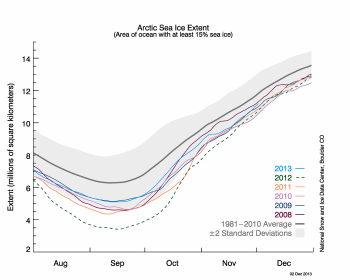
In November, the arctic sea ice extent hit a severe low, although its overall extent was higher than over the previous years (National Snow and Ice Data Center). The figure below displays the sea ice dynamics of the past five years, showing how contrary to popular belief, ice has not been as directly impacted by climate change as people tend to think. Clear however is the trend that it's lower than the 1961-2010 average.

Arctic Sea Ice Extent (Source)


The reasons for this decrease in sea ice extent lie in the surface winds, causing the transpolar drift of sea ice. The increase in their force shortens the period of 'winter', when the ice gets time to thicken and add mass (Rigor and Wallace, 2004). The ice drifts out of the pacific sector, where it remains during 'summer' and advection takes place, thinning the sea ice. As all UCL'ers taking 'Past Climates' will also know, as it has been emphasized by Dr. Maslin, "Winter isn't isn't isn't important. It'll always be cold. It's the summer that does it, how long, how hot, that makes the difference." 
Finally, besides the increased force of winds, the ice albedo feedback is the main influence on sea ice extent. If you remember the very first post, where we discussed this positive feedback mechanism. The thinner ice and larger areas of open water caused by the drifting increase the surface solar heating (Zhang et al., 2008). 

The main concern connected to to ice extent is sea level rise, which would cause problems for many lower lying countries such as the Netherlands and parts of England. And of course, arctic ecosystem change and the acceleration of climate feedbacks are factors to consider.

If you'd like to know more, daily data and overall interesting information is posted every day on the National Snow and Ice Data Center website, which is very worth looking at and helps me contain myself not to bother you with 2000-word posts again. So here's the LINK. 


Also, I wish you a happy new year and hope to see you on the blog again in 2014! 

Cheers,

Larissa

Wednesday, 18 December 2013

Artificial Snow

Hello guys, from beautiful Austria and the snow this time,

After last week's rant, a very brief post today. I want to touch upon the topic of artificial snow, as there's hardly any 'natural' snow over here right now, but still we're able to continue snowboarding.  Seems wasteful and wrong, doesn't it? But also practical, right? Let's have a look.

A typical snow canon. (Source)


The minimum temperature for artificial snow machines is -1 C, so the snow canons can be used almost every night (Teich et al., 2007). However, this has a significant environmental impact and clear pro's and cons. Here's the list!

PRO:

- Securing the snowsports tourism during lack of snow
- Protection of the upper soil layer from ski edges and piste bullies (Mayer et al., 2007)
- Protection of the soil and plants from extreme temperature differences

CON:

- Loudness
- High energy- and water use
- Decline of vegetation diversity due to longer snow cover in May/April

This also leads to high costs: artificial snow for one hectare (100m x 100m) of ground costs 6000 euros per winter (Snowboard Teacher Skript TSLV), which - among other factors - also makes snowsports tourism so expensive. But the pro's outweigh the cons, according to the Tiroleans.

Having to use these snow canons has become more common over the past 40 years. My course convenor today blamed it on climate change. But whether that's explicitly the case is a whole other discussion...


Tuesday, 10 December 2013

The Snowsports Industry: a Critical Analysis

Hi there,

Before you read this, I just ask you to scroll down and have a look at the film trailer I put in my last post. As I mentioned there, today I want to discuss the snowsports industry and climate and environmental change. And this time not what climate change is doing to snow and cold, but how the snowsports industry is doing much to accelerate the process that is so dangerous to its continuation.

Because it's difficult to give world wide examples, I'm going to stick to Austria, but the general conclusions can be extrapolated to the industry in North America and Asia as well, as the results found are similar (Elsasser and Bürki, 2002 and Brown et al., 2006).
In the Tirol in the Austrian Alps, the amount of winter tourists increased with almost 30% over the past 25 years, with a consequent increase in hotels, ski lifts and other types of infrastructure (Statistics Tirol, tourism).

The increased amount of tourists and infrastructure has a multitude of direct and indirect effects, which I have summarized in the figure below.

Figure 1. Interplay between climate change, environmental change, the winter tourism sector and the danger of snow avalanches. The dotted arrows represent indirect effects, the others direct effects. 


Winter tourism has a direct negative effect on vegetation and the ecosystem because of its alterations in order to prepare the area for tourists. The most influential factors here are slope creation, daily slope preparation, usage of the slope, artificial snow creation, terrain alteration through e.g. blowing up of rock formations and clearcutting in mountain woods. (Breitenbach, 2010) 
These factors compact the soil, reduce infiltration capacity, destruct or degrade vegetation cover, intensify surface runoff and increase the development of erosion processes. Ski slopes have notoriously low infiltration rates and water retention capacities, and intensive erosion. (Bjedov et al., 2011). This impairs the original function of these areas as species habitat and endangers the diversity of ecological niches. This especially affects vegetation, which in part includes protected plant species such as the wellknown Austrian Edelweiss (Breitenbach, 2010). 

Other environmental impact occurs because of winter tourism extending to glaciers, where snow cover and snow depth is more consistent due to altitude. Glaciers are important storage basins for drinking water, e.g. the Alpine glaciers for Middle-Europe (Schemel and Erbguth, 2000). 

 Finally, referring back to what I said earlier, the amount of arrivals in the area of Tirol has increased significantly since 1985. The transportation to the Alps, due to emission of toxic gases, impacts the Alpine environment. This environment is already classified with high ecological sensitivity and water and air quality will continue to increasingly suffer (Schemel and Erbguth, 2000).

In conclusion, I want to say three things. First of all: sorry for the incredibly long and maybe boring post, but I needed to get this out there.
Second of all: I am so guilty of all of this too.. so you might call me a hypocrite. In fact, I'm boarding my flight to Austria tomorrow, and I can't wait to be home in the mountains, in beautiful Serfaus.
And finally: this isn't a post to tell everyone to quit skiing. But I ask you to think of HOW you're practicing your sport. If you go for tree runs (best part of snowboarding imo.) be careful in the woods, don't damage trees and check whether it's not wildlife habitat - all ski areas have info on this. Don't litter, if you smoke, don't put your stubs in the snow: this is an important source of drinking water. Go explore your backyard before you decide to board a flight to the Canadian rockies.. Share rides to the mountains: e.g. through the awesome initiative of MOUNTAINRIDESHARE.

So, *switch off preach mode* go enjoy the mountains. Responsibly. 

Wednesday, 4 December 2013

Movie Time! Steps - A Journey to the Edge of Climate Change

Dear all,

Today, just a fantastic trailer that I urge you to watch for 5 reasons:

1) Its topic is exactly what I've been writing about for the past months: climate change hits close to home, especially for the winter sports community. Get inspired to watch the whole film, and (depending on your background), learn something!

2) Beautiful footage of the Swiss Alps, snow, skiing, snowboarding, good soundtrack - the whole works.

3) Read the description, and take away the message. Implement it in your own life: share rides to the mountains, take public transport there, explore your own backyard instead of flying off to Breck. 

4) It's the intro to my next post: the paradox between snowsports and climate change. So far, I've only been talking about climate change and its impacts. Not on how we are doing a great job at helping it along. It's time for my own version of what the makers of STEPS present: a critical analysis of the snowsports community.

5) Enjoy the soothing Schwiizertüütsch. Isn't it the most calming language in the world? Except for a German, trying to convince yourself that you understand the language. No, you don't. 

Cheers for now guys, and enjoy. 

P.S. For the Dutchies out there: happy Sinterklaas!


Source, also see stepsfilm.com